
Huntersville Previous Residents Sources
Different sources answer different parts of a past-residents question. A property record identifies the current parcel, recorded owner, situs, mailing address, and legal description. A deed follows an ownership interest. A directory or census may identify people associated with the address in a particular period. Permit material can date a project or show a named role, but it does not prove household membership. The best trail combines those sources in date order and leaves the source type visible in the notes.
| Source | Years It Covers | Where Held | What It Shows |
|---|---|---|---|
| Current property and GIS record | Current daily dataset | Mecklenburg Office of Tax Administration and GIS | PID, owner, situs, mailing, legal description, sales, and value fields where displayed |
| Modern ROD index and images | March 1990 to present | Aumentum Recorder Public Access and Register of Deeds | Recorded deeds, deeds of trust, plats, and other instruments |
| Historical ROD index and images | 1763 to February 1990 | Mecklenburg Historical Records and the office | Grantor/grantee entries, book/page references, and scanned land records |
| Selected city directories | 1875/76 through 1940 selected runs | Carolina Room, NCGenWeb, and DigitalNC | Historical address and household, occupation, or address-change clues |
| Federal census | 1790 through 1950 public | NARA, FamilySearch, and library databases | Household, age, birthplace, and related census fields, subject to geography changes |
| Permit and code material | Online and archive windows vary | WebPermit, Accela, and Code Enforcement archives | Applications, inspections, certificates, drawings, and named project roles |
Start with the current parcel when the address is known. Start with a dated directory or census when the question concerns an earlier household. Either route should return to the PID, legal description, and deed record before an identity conclusion is made.
Huntersville Address Records Start
A PID is the durable bridge for a Huntersville house-history search. Street numbers can be renumbered, a postal city can differ from town jurisdiction, and a mailing address can be a post office box or business location. The county property and GIS systems distinguish the situs from the mailing address and preserve the legal description used to connect land records. Capture all four before opening a deed: PID, situs address, current owner, and legal description.
The current property portal is the practical starting place for an address, owner, or parcel search. The result may also expose sale and value information. Those fields describe county property records, not a full account of all people at the address. Current ownership and tax correspondence should remain separate from historical occupancy until a directory, census, obituary, or other dated source supports the link.
Huntersville Previous Residents Deed Chain
The backward deed chain is the clearest ownership method for previous residents research. Begin with the current owner and legal description from the parcel record. Search that owner as a grantee, because the grantee is the party receiving the interest. The purchase deed identifies the seller, the grantor. Search that seller as the next grantee to locate an earlier acquisition. Repeating the sequence turns one current record into a dated chain rather than a guess based on a familiar surname.
- Find the current PID, owner, situs, and legal description in the property or GIS record.
- Search the current owner as grantee in the modern deed index and open the purchase instrument.
- Record grantor, grantee, document number or book/page, recording date, legal description, and any plat reference.
- Search the seller from that deed as grantee, then repeat the process through earlier transfers. Check both grantor and grantee spellings and corporate or trust variants.
- At the March 1990 boundary, continue in the historical index with Land, Grantor or Grantee, a year range, Human or Corporation, and a last-name or name-portion search.
- Grantor
- The party transferring a recorded interest in a deed or other instrument.
- Grantee
- The party receiving that recorded interest. Searching the prior seller as grantee is the key backward step.
- Chain of title
- The linked sequence of recorded transfers and interests affecting the same parcel. It is not a complete list of occupants.
- Legal description
- The lot, subdivision, map, or metes-and-bounds wording used in deeds and plats. It is more durable than a street number in older records.
See the Mecklenburg real-estate records information for the office's modern and historical access distinction.
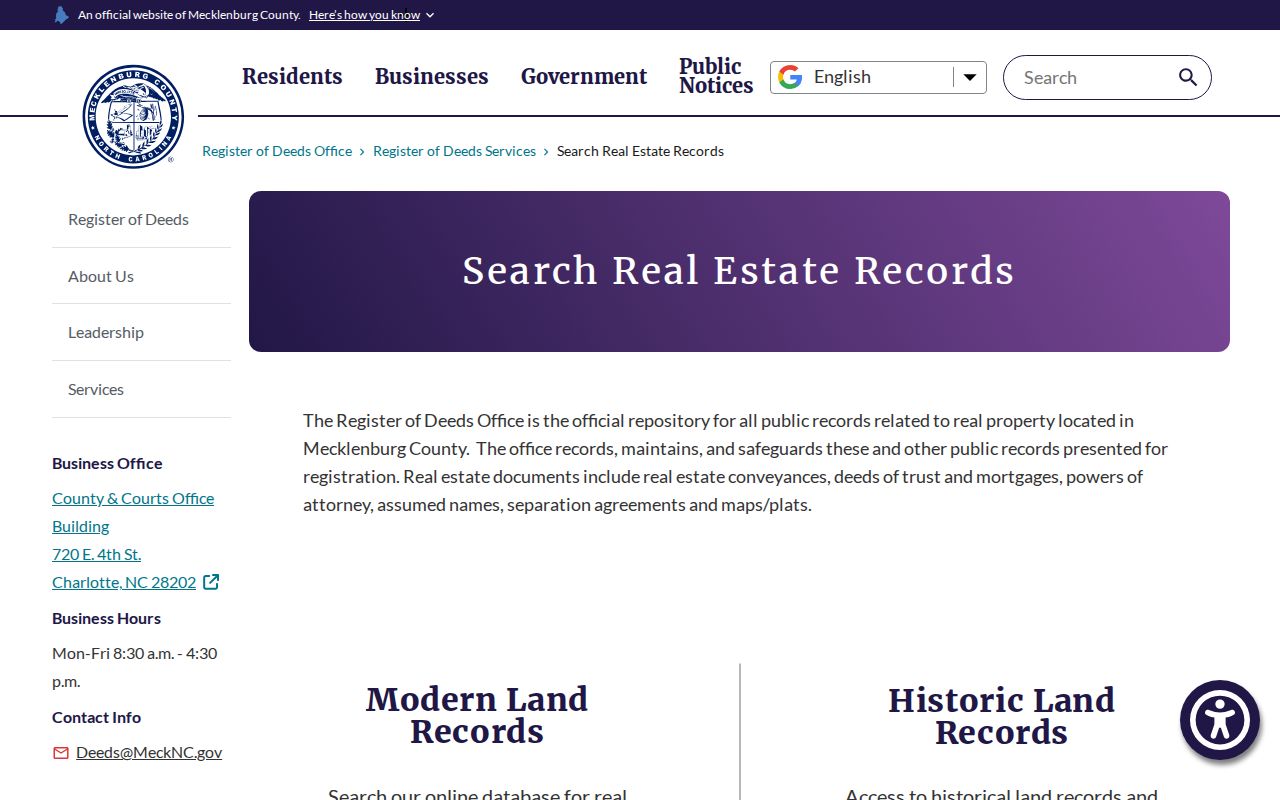
The office page is a useful reminder that an index leads to a recorded document, while an office copy is the authoritative source when one is needed.
Huntersville Historic Records Cutoff
Insider tip. Do not stop when a modern name search finds nothing. Mecklenburg's modern public real-estate index begins in March 1990. The separate historical land-record system reaches from 1763 through February 1990. Crossing the cutoff is a normal part of a Huntersville past-residents trail, not evidence that a parcel had no earlier record.
The modern system begins with a disclaimer acknowledgment and offers public-computer or private-computer choices. In the historical service, results can be loosely alphabetized and similar-sounding names can be grouped. Search both sides of the deed, vary the last-name portion, and use the book/page or image to confirm that the legal description is the same parcel. Historical records include deed books, old deed books, map books, Beers/Butler plats, condominium books, and satisfaction books, so not every book/page result is a conveyance.
View the modern Mecklenburg deed-index entry before using the current-era search route.
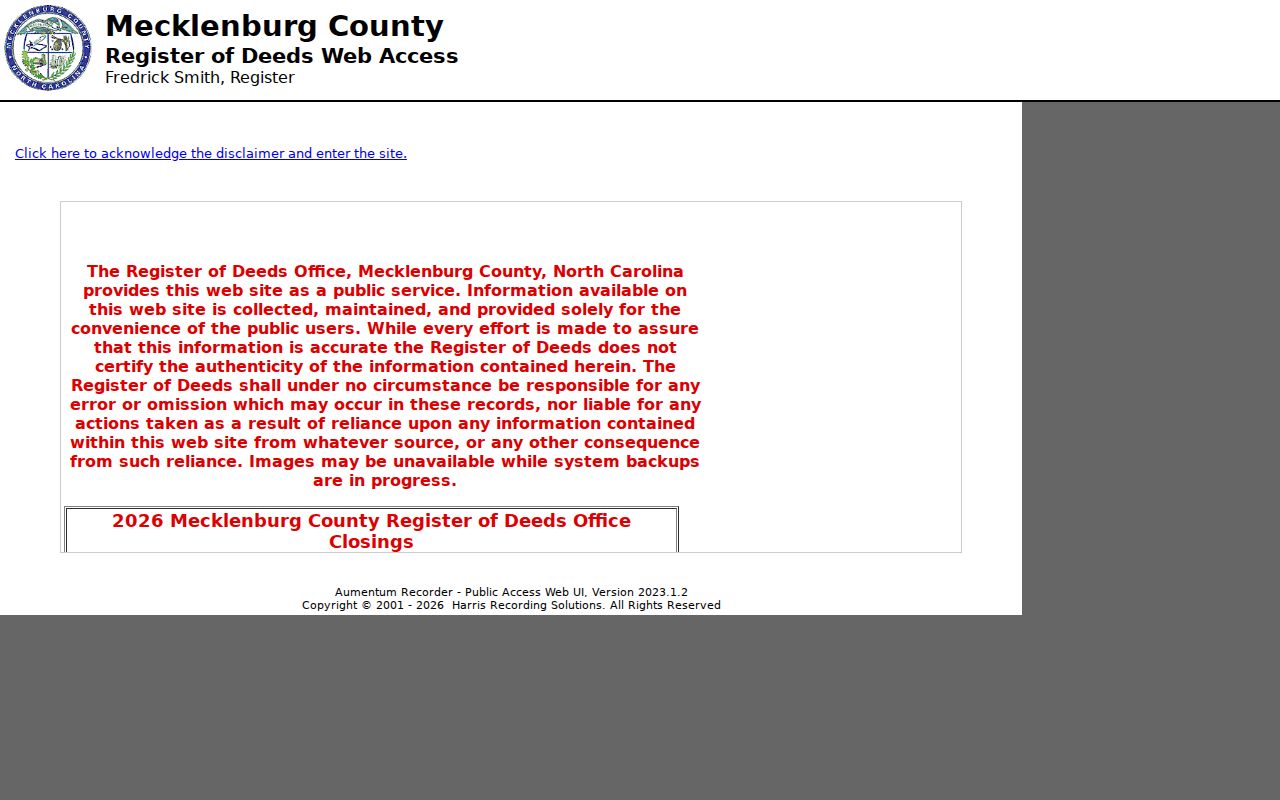
The modern entry point helps separate documents recorded since the index cutoff from the earlier historical search path.
Use the Mecklenburg Historical Records index after the modern cutoff is reached.
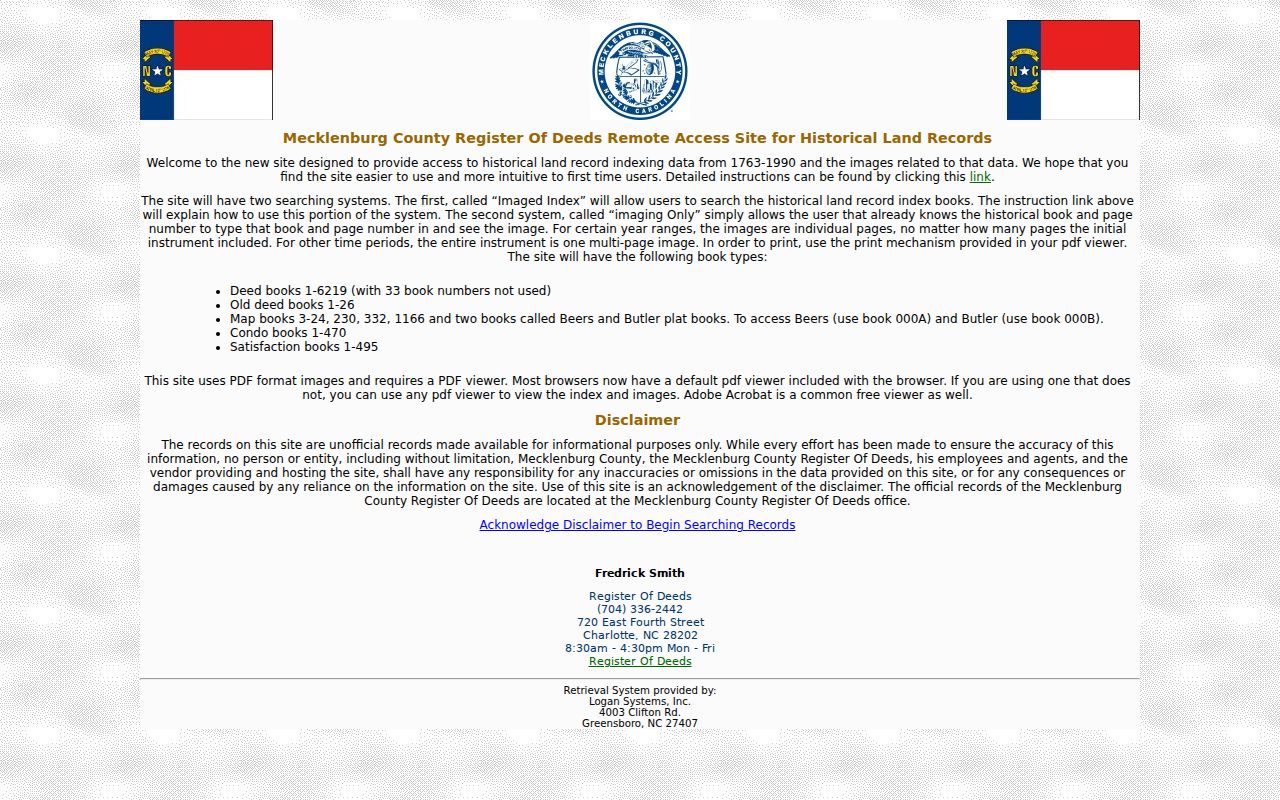
The historical instructions make the year range, grantor or grantee choice, and name-portion search part of the research record.
Huntersville Deed Record Copies
An online deed result is often enough to identify the next document in a chain, but a copy request has a separate cost and access path. The Register of Deeds reports certified real-estate copies at $5 for the first page and $2 for each additional page. Noncertified in-person copies are 25 cents per page, while noncertified mail copies are $1 per page. Online Permitium orders add a stated $4 service fee plus card processing. Confirm the current fee and the document type before ordering.
The Register of Deeds fee schedule shows the office's copy and recording charges.
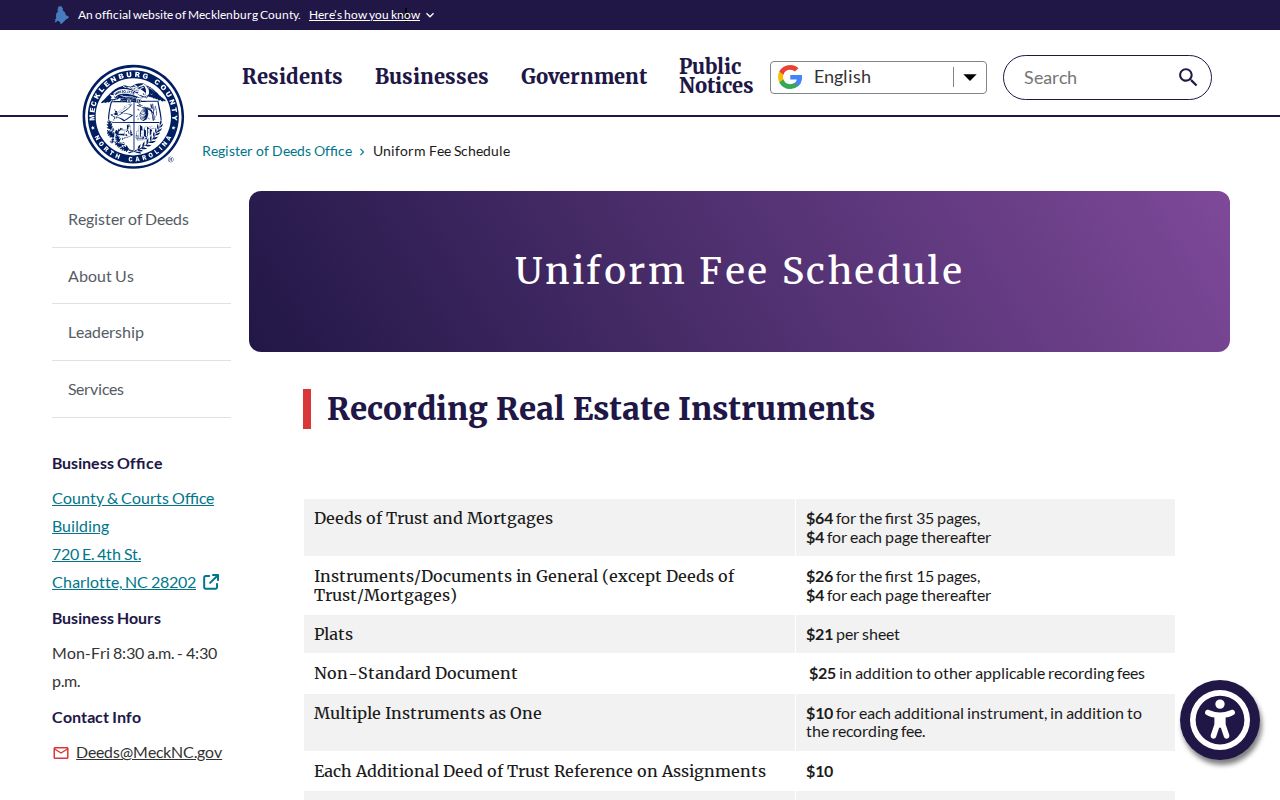
For house history, the document number, legal description, and recorded date should be copied into the research log before any fee is paid for an image or certification.
Note: A deed of trust, satisfaction, lien, or foreclosure item needs later instruments and status context before it is read as a transfer or a current condition.
Huntersville Permit Record Dates
Permit and code material can date construction, additions, inspections, certificates, or compliance work. WebPermit can search by street number and street name or PID, and its broad-search instructions say to leave off suffixes. AccelaMeck is the newer guest-search route for records, permits, plan review, and inspections. Code Enforcement says ordinary online document research generally covers the last six years, while older or specialized records may require a form, walk-in research, microfiche, mainframe, maps, or copies.
Use a permit date as evidence of a project, not as an ownership or occupancy date. A named applicant, contractor, designer, owner, or inspector had a role in the file. The deed recording date documents a recorded land interest. Keeping those events apart makes a past-residents timeline far more reliable.
Huntersville Street-Name Records
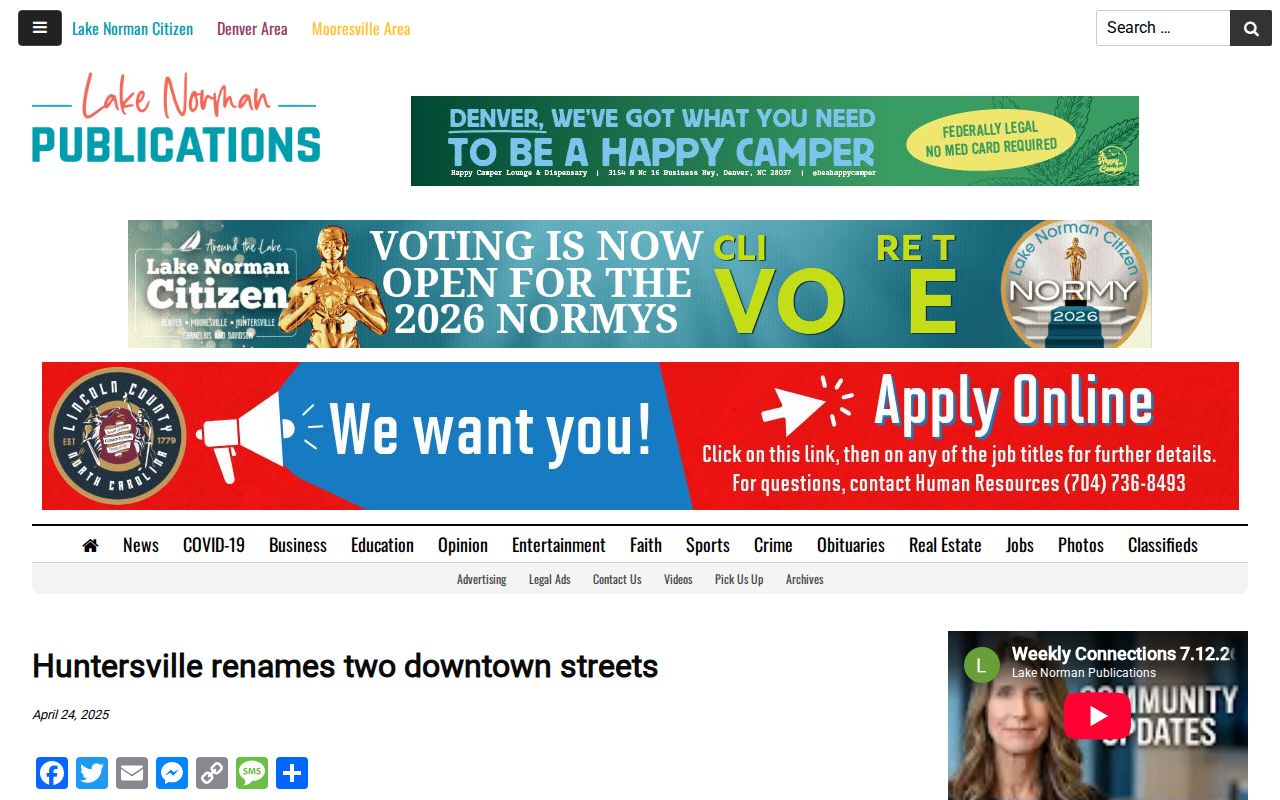
Search both old and current street labels before a name or directory search is ruled out. Effective May 1, 2025, former North Main Street was renamed Thread Lane and former South Main Street became Combs Lane. The update affects permits, deeds, directories, and any source that kept a previous address string. The PID, legal description, subdivision name, and plat are the better bridge when a text search splits the record trail.
See the local Huntersville street-renaming report for the reported name change and its downtown context.
The former-name search is especially important when comparing a printed directory entry with today's property and permit records.
Huntersville Past Residents in Print
Ownership is only one half of a house history. Selected Mecklenburg directory runs exist from 1875/76 through 1940, and the public federal census schedules run from 1790 through 1950. A directory may show a name, spouse notation, occupation, home or residence marker, and address as printed. Read the directory's front matter before interpreting abbreviations such as h or r. A directory is not a complete annual Huntersville roll, and a published entry can lag a move.
- Choose the directory year closest to the known address period and record the address exactly as printed.
- Capture spelling, spouse notation, occupation, house marker, old/new address notation, and the directory page.
- Check the next available directory year, then compare the household with a nearby public census year: 1900, 1910, 1920, 1930, 1940, or 1950 where it fits.
- Return to the deed or tax/GIS trail to determine whether the printed person held a recorded interest or another household connection.
The Carolina Room's newspapers, yearbooks, maps, vertical files, and genealogical materials can supply another dated clue. The Charlotte History Toolkit uses an address-first process through directories, plats, deeds, permits, and newspapers. The Huntersville city directory collections identify the available historical directory shelf without overstating it as a complete town census.
Huntersville Earlier Resident Records
Obituaries and probate can close a historical address trail when a household member died, an estate transferred land, or heirs appear in a court file. The Carolina Room holds county newspapers in print and microfilm, while the Clerk of Superior Court holds estate and special-proceeding records. A newspaper is a useful secondary clue. A probate file, recorded distribution, or later deed can corroborate names and dates. Keep the precise source and event type in the record log.
Maps and Sanborn resources need the same care. Digital Sanborn Maps provides North Carolina coverage for 1867 through 1970, and Charlotte coverage is verified, but no Huntersville-sheet year list was confirmed. Check the actual coverage before citing a map for a particular parcel. Do not treat an unverified map sheet or an obituary alone as final proof of where someone lived.
Huntersville Previous Residents Limits
Past-residents research should stay focused on lawful personal history, family history, and the record of a place. A deed proves a recorded interest, not a household. A mailing address identifies a tax-correspondence destination, not physical presence. Directories, census schedules, permits, and obituaries each have their own date and coverage limits. A protected address can be absent under North Carolina's Address Confidentiality Program or other legal protections.
Lawful personal research. Use Huntersville house-history records with care and do not use them to stalk, harass, intimidate, or disclose a protected address. A narrow request to the right custodian is safer than trying to reconstruct a private household from scattered clues.
North Carolina Public Records Law, Chapter 132, supports inspection of many public records, but it does not require an agency to create a new compilation. When the trail ends, request a specific record type, date range, address, PID, or document number from the office that holds it.